Showing posts with label ultramarathon. Show all posts

Wednesday, November 28, 2012

Is going long a bad idea in the long run?


It turns out that running, pretty much like everything else in life, may be best for you when taken in moderation.

A review article published by James H. O'Keefe and others in the June 2012 issue of Mayo Clinic Proceedings suggests that the type of chronic, high-intensity exercise that marathoners, ultramarathoners, triathletes, and long-distance cyclists participate in damages the heart (article here, review here). This damage, termed cardiac remodelling, is caused by repeatedly making the heart work really hard for really long periods of time. The result is myocardial fibrosis, arterial calcification, stiffening of the arterial walls, and a reduction in diastolic function. Yikes!

The authors don't suggest running is bad. In fact, the opening sentence of their article touts running as a cornerstone for cardiovascular and overall health. They also are quick to point out that these adverse effects from high intensity exercise are an untested hypothesis and that inconsistencies in the data do exist.

What does all this mean? Go for a run. There is a large and growing body of evidence that running not only improves the length of your life but the quality of your life. How long you run depends, in part, on why you run in the first place. If your main focus is increased longevity then, according to Dr. O'Keefe, you may be doing more harm than good if you run more than 3 to 4 miles more than a couple of times a week. But how many ultramarathon-type athletes are motivated by cardiovascular health alone?

Personally, cardiovascular health is definitely a perk of running but it hardly gets me out the door, or up that mountain pass, or through the final hours of the second long run of the weekend. There are so many other reasons that I run and that I like to run long in particular. Heck, it takes nearly 3 miles to shake the cobwebs out of my muscles and settle into a comfortable groove. If that's when I stopped I'd surely quit altogether, which would be even worse for my ticker.

I think the jury is still out on whether endurance running is bad for your heart. I don't know how motivated I would be if I knew my efforts were taking years off my life. Time and more data will determine whether that's true. In the mean time, I'll keep running.

UPDATE: A new editorial by the authors (O'Keefe and Lavie. 2012. Run for your life... at a comfortable speed and not too far. Heart doi: 10.1136/heartjnl-2012-302886; reviewed by Outside magazine here) provides some guidelines for heart-healthy running. If longevity is your focus they suggest you can improve your cardiovascular health by limiting your running to < 1 - 2 hour per day, < 5 days per week, and at a pace slower than 8 min/mile (5 min/km). Better yet, they suggest you walk, don't run.

The data are still correlative and far from overwhelming. (Never trust a graph without blatant estimates of variance!) There also is no mention of potential differences in the quality of life between exercise regimes. The authors admit their exercise guidelines are aimed at maximizing heart health and not heart fitness and aerobic capacity, which may be important characteristics of a high quality of life for some people. They also make no mention of the many other physical and mental benefits associated with running and how they might vary with intensity.

Ultimately, how long you run will be determined by your reasons for running. If you run strictly for your health it's unlikely that your exercise habits would be classified as excessive anyway and you're probably happy to learn that you can gain the same benefits or better with less effort. If you run because you like to run and you enjoy a good, strenuous effort on a regular basis you may decide that's not worth giving up for some benefit that you may or may not realize in your twilight years. Even O'Keefe admits that "driving to [a] marathon is a hell of a lot more dangerous than running in it".

Now someone remind me, will this cup of coffee enhance my performance or hinder it?

Tuesday, July 19, 2011

running the water numbers

Byron Powell's ultramarathon how-to book is currently on my reading shelf. Unfortunately it's usually buried under a pile of science papers so I don't pick it up as often as I'd like but that's a trail I don't want to run down right now. From what I have read it appears there is useful information for beginner and veteran runners. Get your own copy at iRunFar.

After my Sinister7 dnf I've decided I need to add a bit more rigor to my racing and training. I particularly want to develop a fueling strategy for Lost Souls. Up to this point I've tried to eat and drink frequently without any definition of what that means.

Following Bryon's section on fluid loss I did a little test of how much water I need to consume every hour to prevent dehydration. I went for a 25.3 km run at a 5:46/km pace (so says my gps watch). The entire trip took 2:26. It was calm, blue skies and 24 deg Celsius. A nice summer day. I lost 8 pounds in sweat! I know I sweat more than the average fella and, given my lack of hot weather running, I expected to be pretty sweaty but that's 4 litres of water. According to Bryon's figures I need to consume 1.65 litres of water per hour to remain hydrated. I don't think that's physically possible. I can feel the sloshing in my stomach as I type.

I obviously don't run that fast on longer outings, which will lower my fluid needs. I will hopefully acclimate to the heat over the next 6 weeks, which should further reduce my sweatiness. I also need to repeat this test a couple of times to confirm that number (and hope its not that high again). Whatever the final number what is clear is that I need to consume way more fluids than I have been.

Friday, July 15, 2011

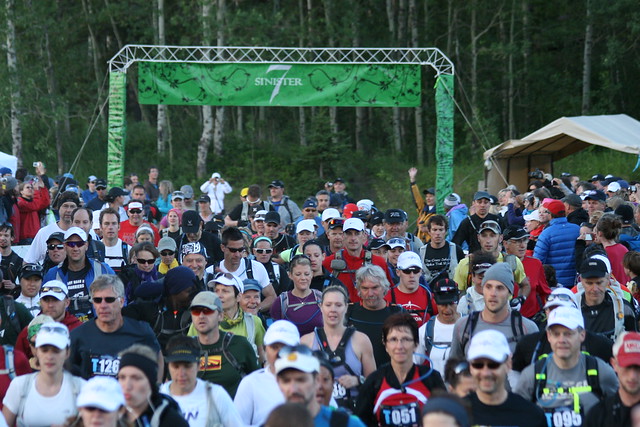
Sinister 7: dnf

IMG_6535
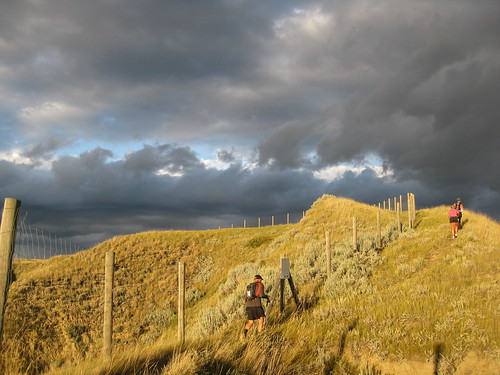
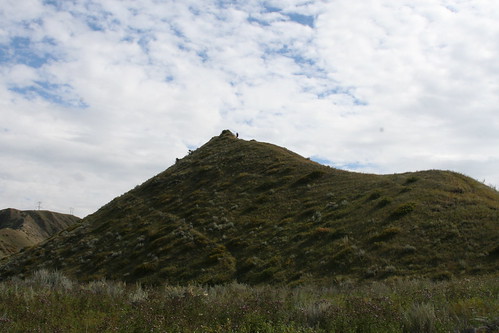
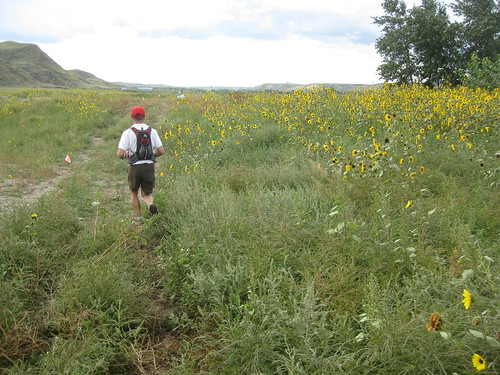
That was ugly. Unfortunately my race went as feared rather than hoped. I dropped out part way through the 4th leg with swollen hands and uncontrollable muscle cramps in my legs. This was a hard course. The race director wasn't kidding when he said, "There are no easy legs. Some are just harder than others."
IMG_1873
Less than a quarter of the registered soloist finished. That doesn't make me feel any better about my own performance. I know what went wrong:

1) I was grossly under-prepared. This was largely my fault. A month of field work and crappy weather didn't help but I became complacent with my training. I hadn't done any hill training. The last hill I climbed that I didn't ski down was Lost Souls 2010. My overall mileage also was way down. I've been rather uninspired to run lately. It's felt more like a job than a pleasure and I've got enough work on my plate right now to take on anything else. Hopefully I find that spark again.
IMG_1868
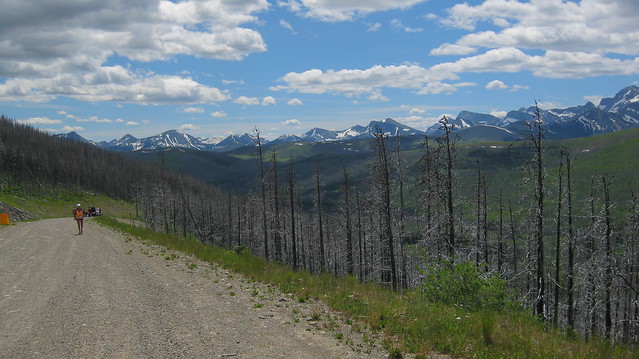
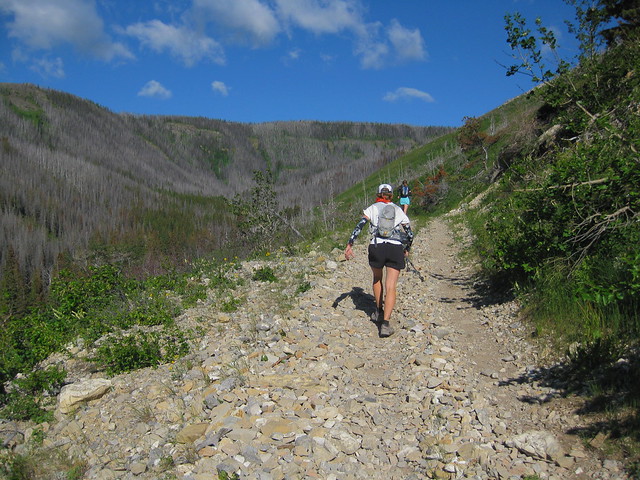
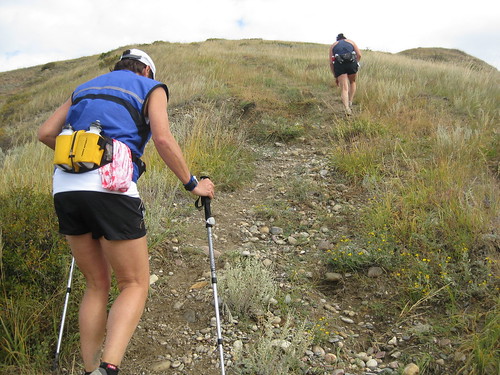
2) I went out faster than I could sustain given my level of training and my unfamiliarity with the course. I kept telling myself 'this terrain will slack off soon and I'll catch a breather.' It never did. The brutal uphills, which were often so steep they were difficult to walk, were often followed by equally steep downhills that took just as much concentration and strength to descend. Leg 2, in particular, was way more difficult than I expected given it's relatively moderate ranking among legs.
IMG_1842
3) My fueling was way off. Temperatures were higher than I was use to and I was quickly running a fluid deficit that I was never able to make up. As the dehydration grew my appetite shrank and my condition went from bad to worse. I tell myself the same thing after every race: "drink early and drink often". This course was too unforgiving to let me get away with not heeding my own warning. I need to make a fueling plan for Lost Souls that I will follow.
IMG_6511
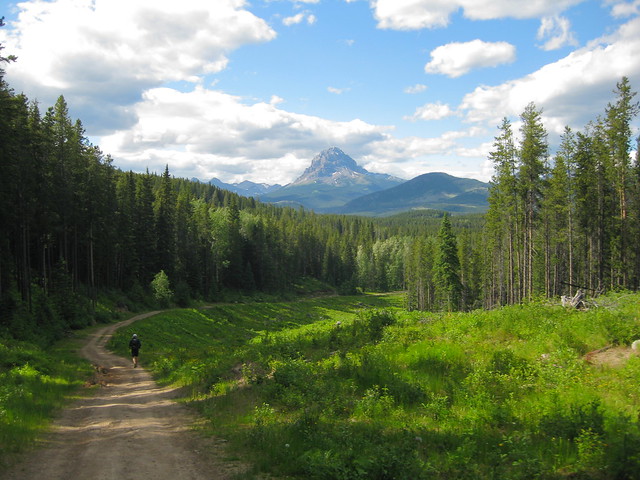
What I saw of the course was beautiful and I look forward to toeing the line next year.
IMG_6590

Friday, April 29, 2011

t.o.f. ultramarathon training plan

When I began training for my first ultra I had a lot of questions – how far, how fast, how often, what to eat, what to wear…. I spent a lot of time on the internets researching what others were doing. Now I’m being asked those same questions. Mostly the questions are out of curiosity but they also come from runners interested in a new challenge. So, for what it’s worth, I thought I’d do a series of posts about what works for me.

How do you train to run 100 miles?” Not surprisingly, there are many approaches to training for an ultra. Some focus heavily on speed work or hill repeats whereas others cross-train or run on a treadmill to avoid injury. This variety seems to reflect differences in personal preference and mental/physical tolerance rather than recipes for success. However, most training tips and plans share a common message –it’s all about spending time on your feet. Whether fast or slow, up hills or across the prairies, to run far you need to spend a lot of time running.
IMG_1236
My time-on-feet ultramarathon training plan is a modification of a Runner’s World 16-week, 50-mile program. In general, I put less emphasis on speed work and I increase the length of the long runs. Here’s what a typical week looks like:

M: rest
Tu: 15 km hard
W: 10 km easy
Th: 15 km hard
Fr: rest
Sa: long
Su: long

Tuesday and Thursday are tempo runs with repeats from 20 to 60 minutes. If I’m training for a hilly race I’ll do hill repeats instead. I do speed work because I enjoy it, not because I think it’s important to finishing an ultra. If I’m tired it’s the first thing to go. I still cover the distance I just do it at an easy pace.

Wednesday is 1 to 2 minutes slower per km than Tu and Th. My primary goal is pacing, which I’m terrible at – every run would be a tempo run if I didn’t constantly slow myself down. I pick a slow pace and try to maintain it and I use a gps watch to ensure that happens.

The back-to-back weekend long runs range between 6 and 14 cumulative hours. The Saturday run is typically longer and slower than the Sunday run. The goal is to acclimate to the mental and physical challenges of running for a long time. If you can’t run the full distance then walk as fast as you can. Few people run an entire race anyway. What’s important is spending time on your feet.

This is an optimistic schedule that I regularly don’t complete. If I did I would spend all my free time running and I don’t like running that much. (I'll write about motivation in the future.) I don’t cross-train but I often replace one or both weekend runs with other things I enjoy like telemark skiing and cycling, particularly if I’m many weeks away from my next race. However, if you think I’m slacking you should come biking with me. Bring a big lunch; we’ll be out for a while.

Thursday, February 3, 2011

Are we born to run?

Chris McDougall is a great storyteller who presents a compelling thesis about our running heritage. I like the notion that we were built for the long haul. McDougall loses my interest and support when he rails against the running shoe industry for being the Achilles' heel of runners. Professional runners don't blame their shoes when they get injured and they log more miles than anyone. When running injuries come up in conversation it's usually not two runners comparing war wounds. It's usually a non-runner recounting the story of an injured runner-friend to a runner in the subtext of 'runners are idiots'. I would bet dollars to donuts that the vast majority of running injuries are due to over-training whether you're a neophyte or a professional.

I do agree with McDougall that we as runners need to rediscover the joy of running. That does not mean throwing away your running shoes, as he suggests. Instead, throw away the mindset that running is penance for a poor diet, or that running is solely a remedy for some malady, or that you must constantly push your limits to get any benefit. Most importantly from an injury perspective, running needn't be so goal-oriented. Why can't we just run for fun?

I've been running, in running shoes, for >20 years without injury and I know I'm not alone. My running has goals, but these are very recent and they are not why I run. I run for the pleasure of running. I like to be outside in the fresh air and sunshine, and I like to experience the world I live in other than through a car window or on television. Every run is an adventure even if it's a regular route. In my opinion, that's the key to injury prevention.

Friday, September 17, 2010

Lost Soul Ultra

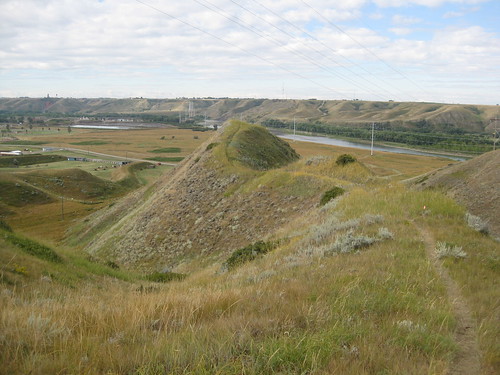
coulee (kū'lē): A deep gulch or ravine with sloping sides, often dry in summer.

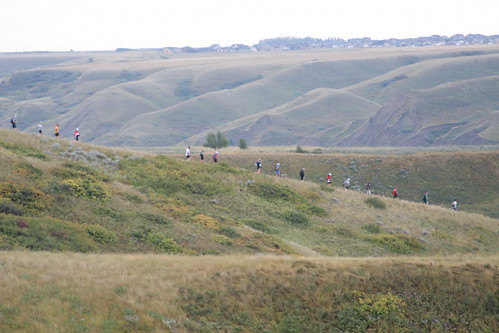
You might have to be from the prairies to know what a coulee is. However, you don't have to be a prairie person to appreciate the beauty of this course. Three laps, 6 legs per lap, up and down the banks of the Old Man River valley through the city of Lethbridge.
IMG_5428
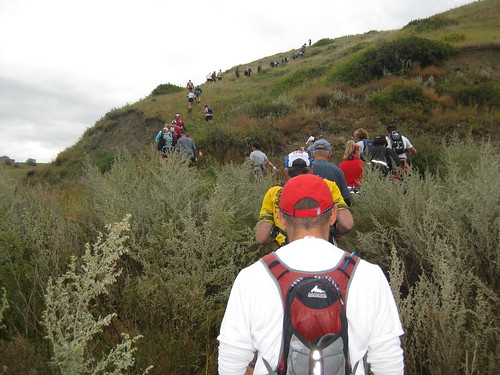
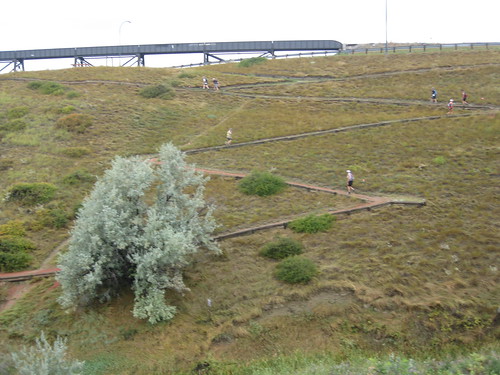
This was the trail-iest trail race I'd ever run - 99% of the course was unpaved and, of that, more than 90% was single-track. Narrow, steep, and often overgrown single-track running up and down the coulees.
IMG_0976
Race HQ and the start/finish line was in the back parking lot of the Lethbridge Lodge.
IMG_0965
The first leg heads south, descending to the valley bottom.
IMG_5335
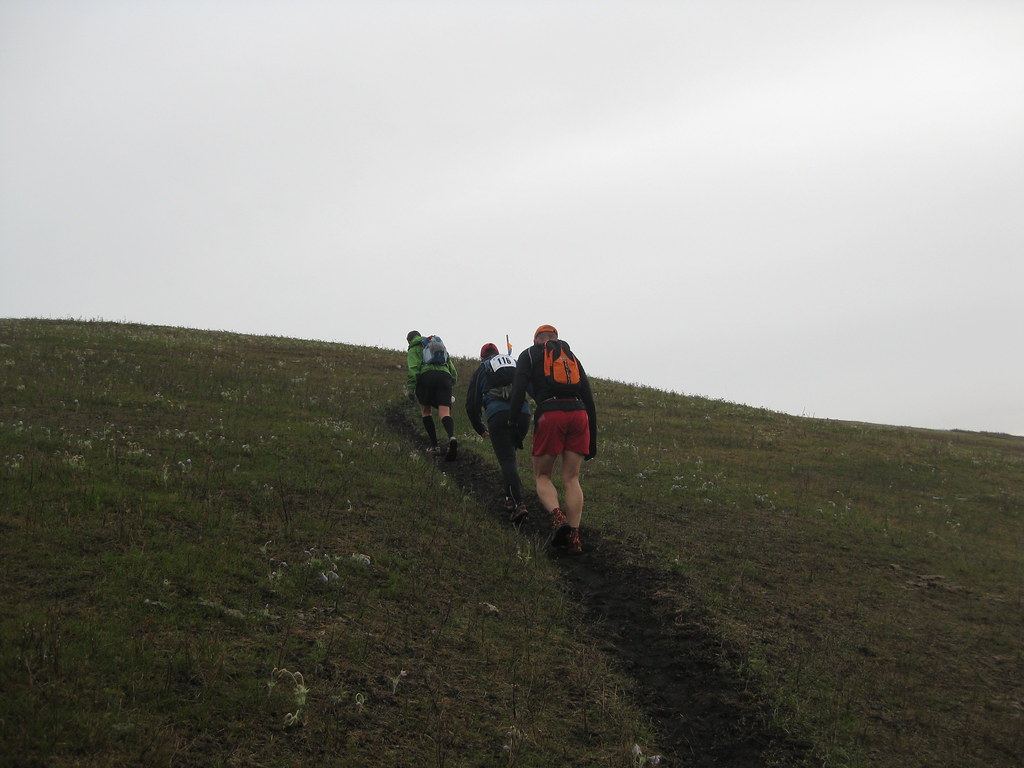
The climbing begins almost immediately
IMG_0969
and is repeated over
IMG_0972
and over
IMG_0977
for the first 3.5 legs.
IMG_0994
Several of the competitors, which had also finished the Death Race, said the Lost Soul was harder. I disagree. True, Lost Soul 100 mile has about 18,000 feet of elevation change, which is comparable to the Death Race. However, most of the Death Race elevation change comes in big, ass-kicking chunks with each of the three peaks. In comparison, Lost Soul is the death of 1000 cuts. Each hill is small but there are sooooo many of them.
IMG_5359
The remaining 2.5 legs were largely flat (only 3 climbs) and followed the river bottom back to the start/finish.
IMG_0990
A single storm cloud passed through and in minutes the trail became gumbo. Fortunately it dried out nearly as fast so the running only sucked for a short while.
IMG_0992
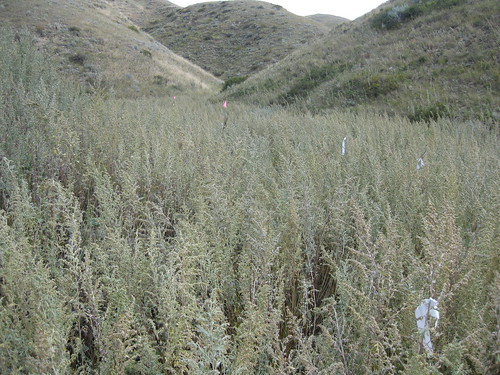
With all the rain the normally scorched coulees were lush. Yes, there is a trail through there but I couldn't see it either until the third lap.
IMG_0980
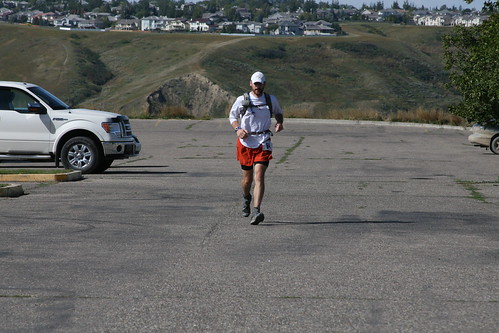
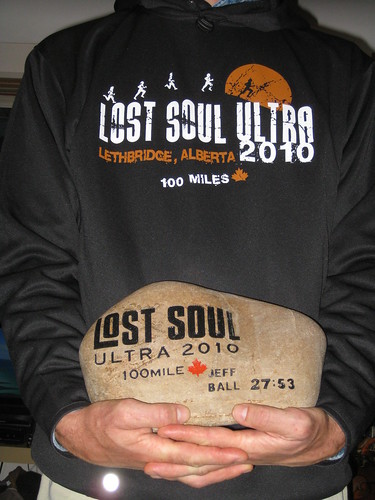
Fifty-three runners started the 100 mile race. Twenty finished. The winning time was 23:06:26 (WOW!). I finished 4th overall in 27:53:06. I was 2.5 hours behind 3rd and 30 minutes ahead of 5th so it was a solid fourth. I'm so pleased with my performance. And surprised. This was the furthest and longest I'd ever run. My goal was to finish. Placing third in my age category (18-49) was icing on the cake. Here I am, busting for the finish line.
IMG_5439
I'd heard horror stories about Lost Soul at each race I went to this summer and I was dreading what I expected to be an unending painfest. I had little motivation when I toed the line. Three things kept me in this race. 1) I wanted to finish for my wife/support crew. I may have done all the training but she made many sacrifices for me to get to this point. 2) I didn't want to admit a DNF. Facebooking my intent of running this race to friends and family was a powerful motivator to finish. 3) Finishing the Alberta Triple.

Now that I've done it I'd run it again. The volunteers were awesome, the organization was top-notch, and the course was both gorgeous and challenging. I thought I'd hate running 3 loops of the same course - I thought the lack of new scenery on top of growing exhaustion would kill what little motivation I had. That turned out not to be the case. The second loop was in the dark so it looked totally different from the first loop. The familiarity with the course on the third loop, and knowing each accomplishment was a final task, was a strong motivator to get each leg done.
IMG_0999

Tuesday, August 3, 2010

Canadian Death Race

I remember seeing an ad in Outside magazine nearly 10 years ago about this ultramarathon called the Death Race. "125 km, 3 summits, 1 river crossing. Are you tough enough?", was the gist of the caption. Ballsy, I thought.

Well I've had a romantic notion about running this race ever since. There's a reason Canadian running magazine calls this a must-do trail race. The challenge is epic, the scenery is spectacular, and the volunteers are amazing. If you're up for a challenge I would definitely recommend this race. But be ready for a challenge - less than half of the 333 soloists that started finished within the 24 hour cut-off. Another 85 registered runners failed to start.

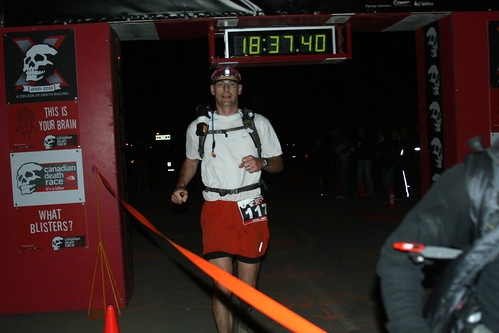
I finished 25th with an unofficial time of 18:32:02, which I'm really happy with (4th in my age category!). However, this is a race report so the following is a closer look at my performance solely from a finishing time perspective.

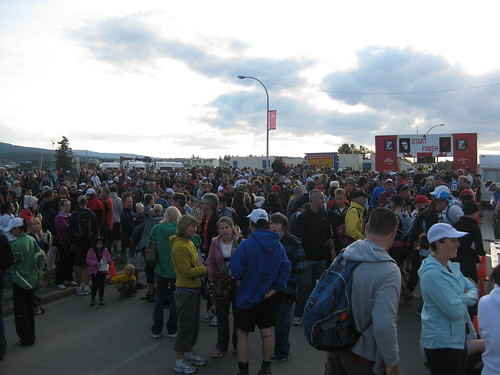
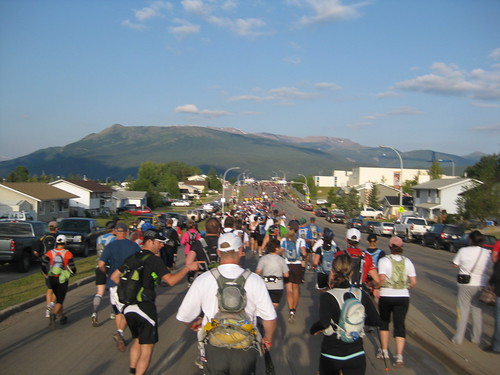
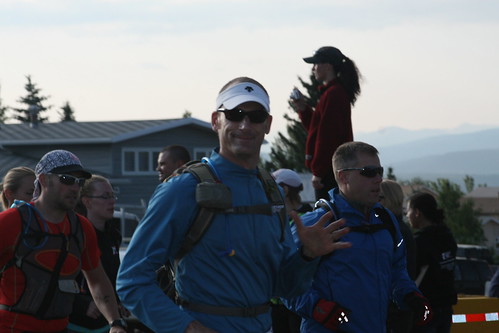
I "lost" this race before it began by starting mid-pack. Here we are waiting for the national anthem and the starting gun.
IMG_0855
Starting mid-pack meant becoming unexpectedly trapped for the better part of the first 30 km. Heading south on Hoppe Ave.
IMG_0858
before making a hairpin turn, passing through the start/finish line again
IMG_5289
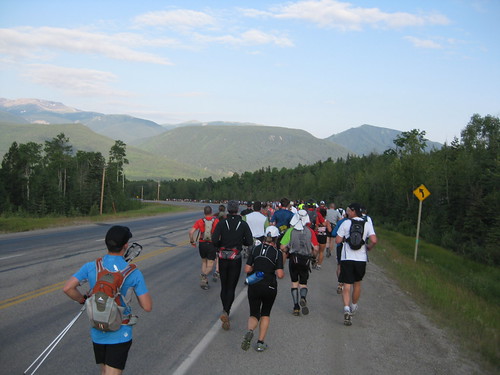
and heading out of town on Highway 40.
IMG_0861
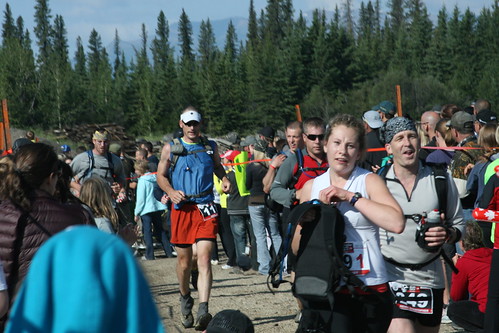
At this point the entire field crammed onto a single-track trail and proceeded mule train-style to the first aid station. This was extremely frustrating. There were too many people on too narrow of a trail to allow passing so, rather than being able to run my own race, I was stuck with many others in this mule train. I finished leg 1 in 164 place among soloists. Mid-pack.
IMG_5291
Leg 2 did not start on a better note - the mule train continued its slow, tedious slog up Flood Mt. I'm all about walking up hills, especially steep ones, but when the angle slacked off and the pace didn't increase accordingly I found myself yelling "time to run" from the back of the train. This would be my last Death race, I told myself.
IMG_0865
 After topping out on Flood Mt both my race and my outlook improved dramatically.
IMG_0869
I "won" this race on the downhills of leg 2. I hate not taking full advantage of gravity so I run down hills at a good clip. Climbing to the summit of Grande Mt before descending 640 m over 6 km to station 2. I must have sounded like a freight train because people were scrambling to get out of way. I'm undecided whether this approach is easier on the quads than a more-controlled descent but the time-savings is undeniable. My pace increased to 30th fastest among soloists for that leg.
IMG_0871
I maintained this pace-standing over the next two legs despite fried quads and rising temperatures. Mt Hamel, the objective of leg 4, is more than 1000 m up over a 10 km stretch. Temperatures reached 23 deg C without a breeze - there were swarms of mosquitoes on Hamel`s ridge! - and several of us suffered muscle cramping and were forced to walk.
IMG_5307
Cool evening temperatures and a half dozen salt tablets had me running and smiling on the backside of Hamel. I finished leg 4 in the dark.
IMG_0875
I also "won" this race on the final leg by increasing my leg-standing to 19th fastest. I don't know if I got faster or the rest of the pack got slower. Maybe I found extra effort in the awesome cheese pizza I ate at the last aid station. Whatever the reason I found enough energy to run up the final hill to the finish line.
IMG_5309
Much thanks to the misses for taking photos and for keeping me fed and watered. This was a team effort.

Thursday, May 13, 2010

looking forward to Death (Race)

I took a week off from training following the Iron Horse to recover. It was nice having an extra 10+ hours to catch up on the rest of my life. Sadly, with the wife out of town I realized I don't have much of a life so I'm looking forward to running again. It's time to begin preparing for the Canadian Death Race. This is a good thing because I forgot to tell my appetite to take the week off too.

What did I learn from my first ultra and what will I do different?
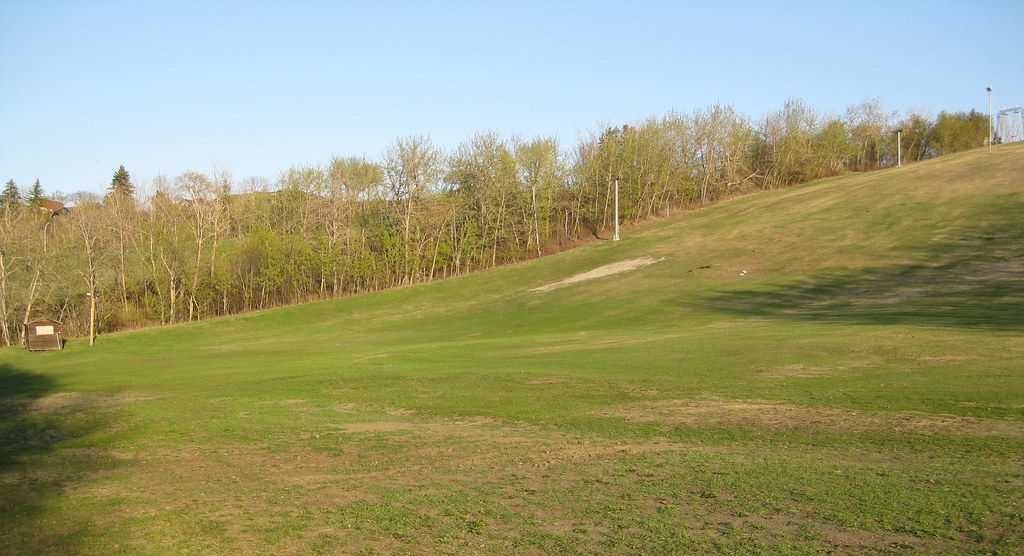
1. Add hills to my training. I felt that I finished Iron Horse strong - I was still running right to the end. However, my only goal was to finish. I don't intend to set a loftier goal for the Death Race but the course is longer and harder and I want to ensure that making the cut-off time is a non-issue. The problem is Edmonton is flat. I ran my first hill workout on the local riverbank-turned-ski hill by my house: bottom to top in under 1 minute. I will need to make a few trips to the mountains before race date.

2. Stretch. Period. I'm not proposing that I need to take my stretching to a higher level like yoga or something. I don't have a level. I need to start stretching. I use to be able to touch my toes. The thought of reaching for my toes now makes me wince.

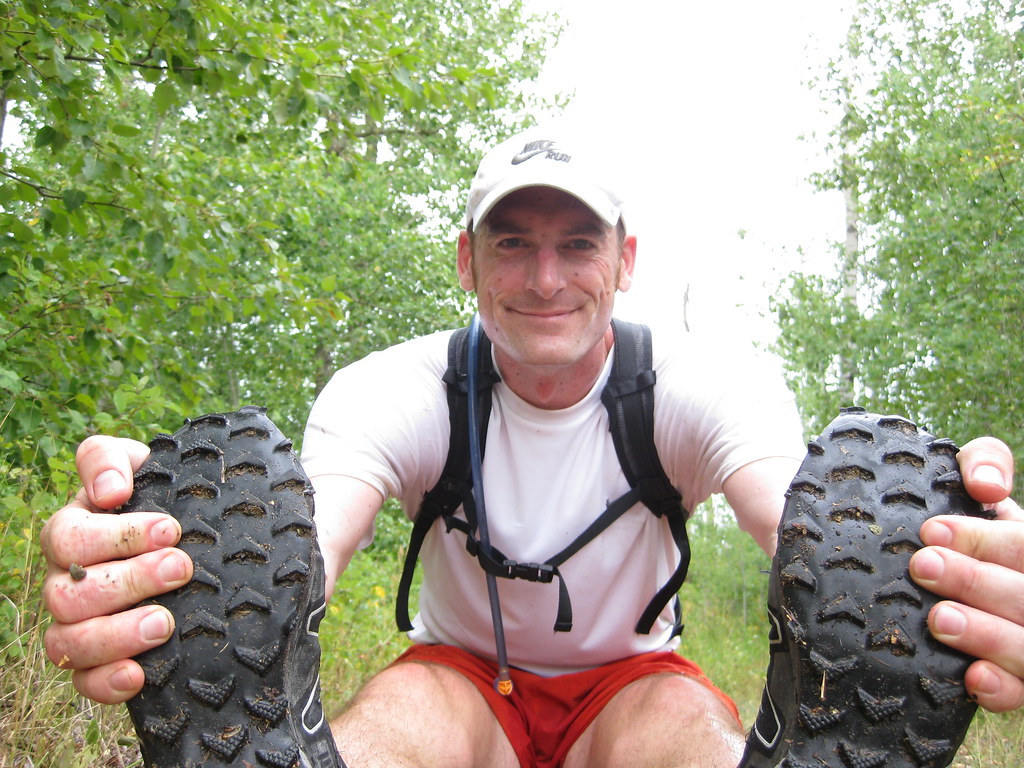
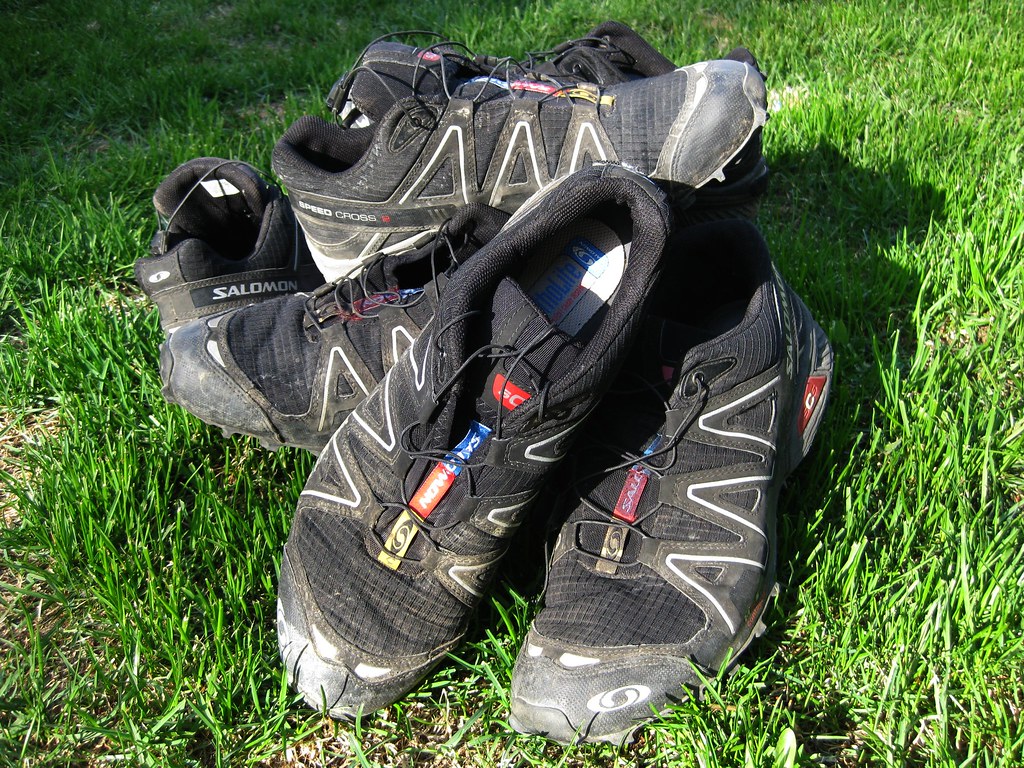
3. Experiment with different shoes. I love my Speedcross2 shoes but my hips and knees were very sore by the end. This may be inevitable regardless of the model of shoes I wear but I only have experience with one model over that distance so I should at least try something else.

4. Be strategic in the aid stations. It was pointed out to me that 5 aid stations at 10 minutes per station is nearly an hour of extra time on the course. I don't think I dawdle but I want to remain conscious of this potential time vortex. My fueling strategy worked well so I won't be changing anything there.

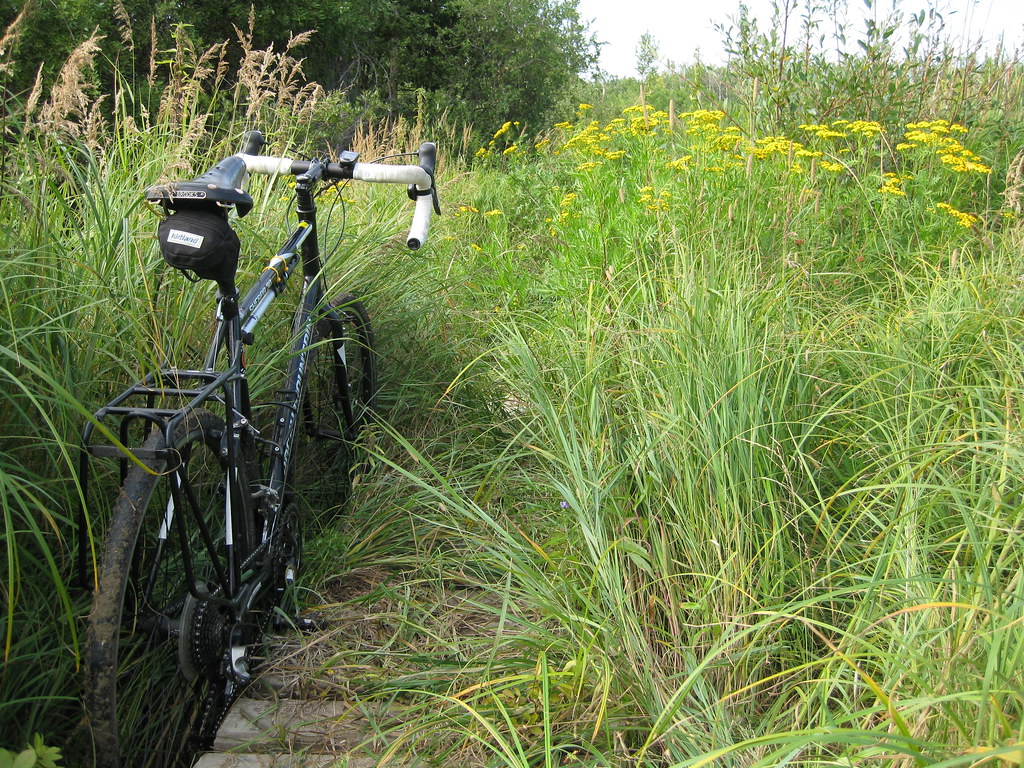
5. Have more fun training. This will be easy to accomplish now that winter is over. Preparing for a spring race in a northern climate was a challenge for someone who runs for adventure rather than fitness. I like the cold and snow. But when cold and snow is all you get for 4+ months running becomes monotonous plodding in the dark on the same few routes that are routinely plowed. I've already swapped cyclocross tires onto my touring bike in anticipation of the coming fun.

Wednesday, May 5, 2010

Iron Horse Ultra

This was my first 'real' ultramarathon. At 100 km, the Iron Horse Ultra was nearly double the furthest I'd ever consecutively run. I did complete the Frozen Ass 50 k in February, but that was really just an extended marathon and part of my weekly training for this race.

This was a perfect first race for me. I run to explore and this course continually had new and interesting terrain that was challenging without being ridiculously hard. (Disclaimer - I grew up on the prairies and I still feel a special connection to these landscapes like possibly only a prairie person can.) There were stretches through valleys, across fields, along river banks, gravel roads, power lines, and forest trails. Due to a last minute rerouting there was even a 100 m stretch where there was no trail, just hummocks of grass separating pools of water.

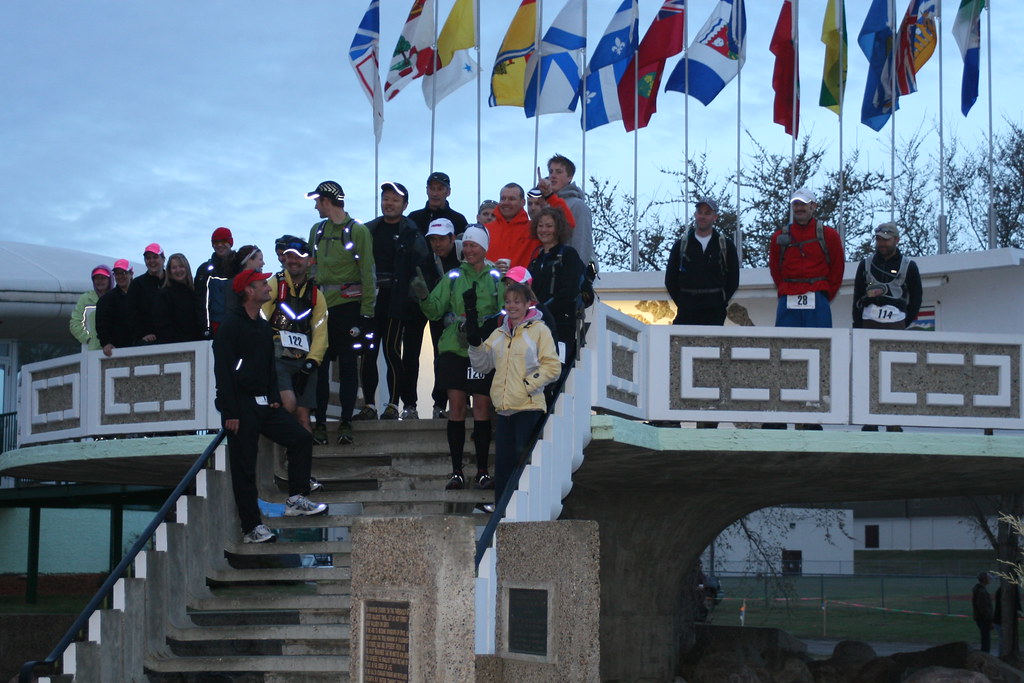
We started at 6 am with a group photo on the UFO landing pad before walking the 2 blocks to the actual starting line on the reclaimed CNR railway bed.

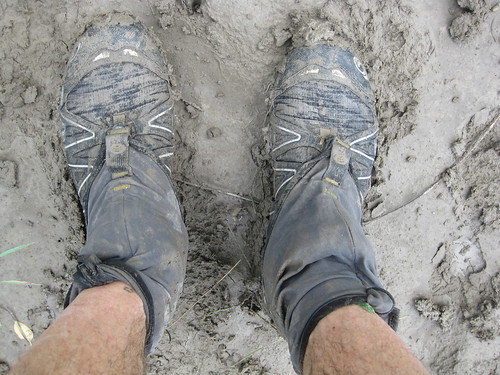
The first half of Leg 1 followed the old railway bed. Thankfully the previous day was warm and windy, which dried much of the rain and snow that fell earlier in the week. Still the rail bed was ridiculously muddy in spots, which made me very nervous. It was the kind of mud that sticks to your shoes like glue and adds pounds to each step. I didn't train with ankle weights and I doubted my ability to make the first aid station in such conditions.

The mud ended when we climbed out of the railway valley.

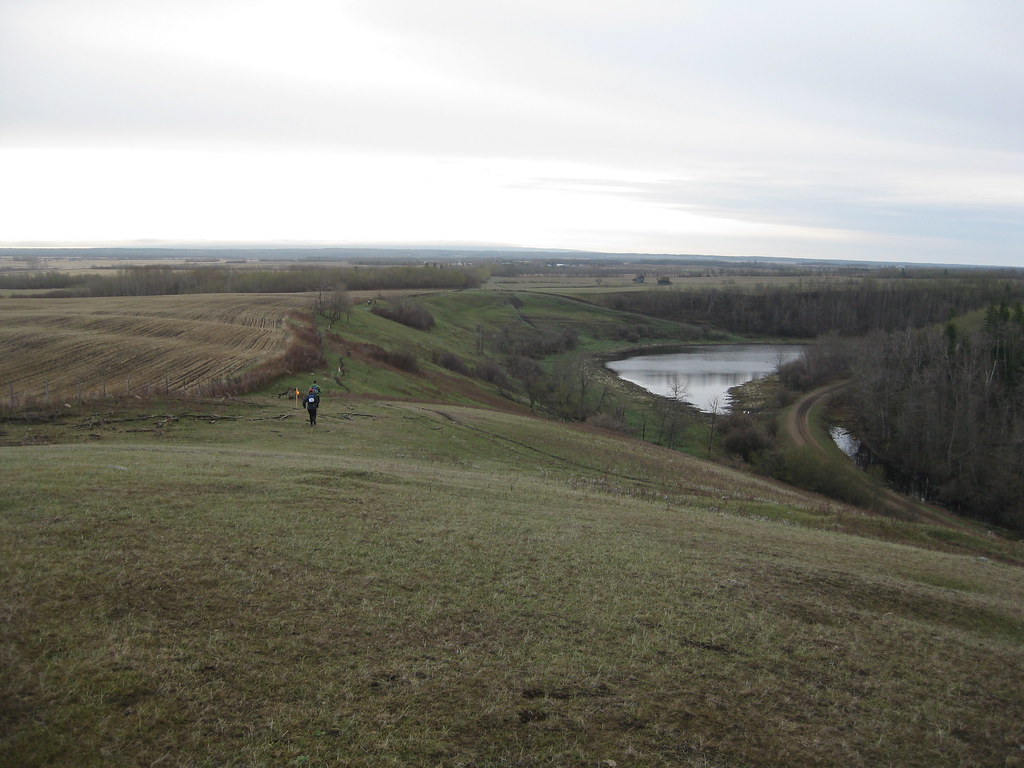
The view's improved, too - prairie folks like to see the horizon.

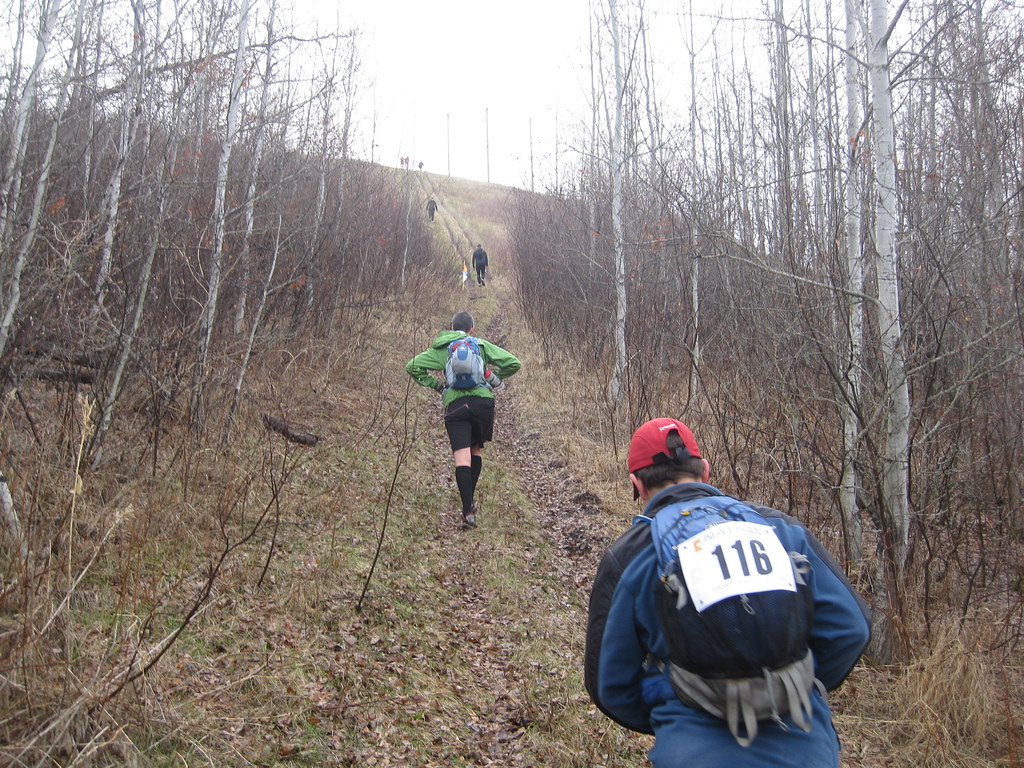
At this point we began a series of ascents and descents as trail followed the valley to the first aid station.


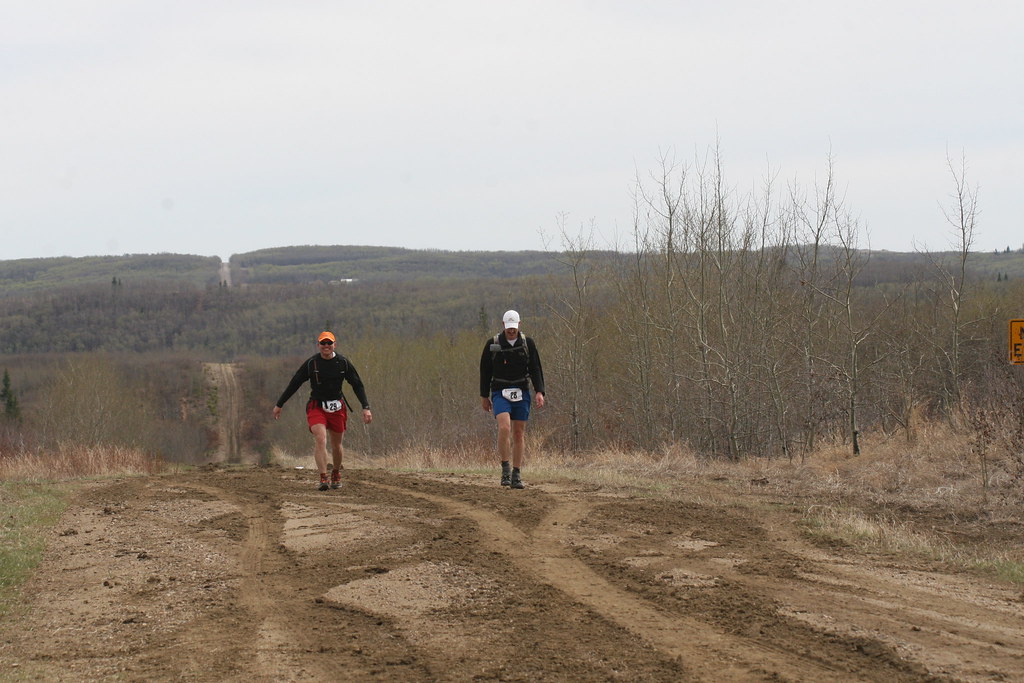
Leg 2 was the least interesting overall. Much of this leg was an arrow-straight gravel road that continually climbed at an angle that was steep enough to be tiring but was not so steep to justify walking.


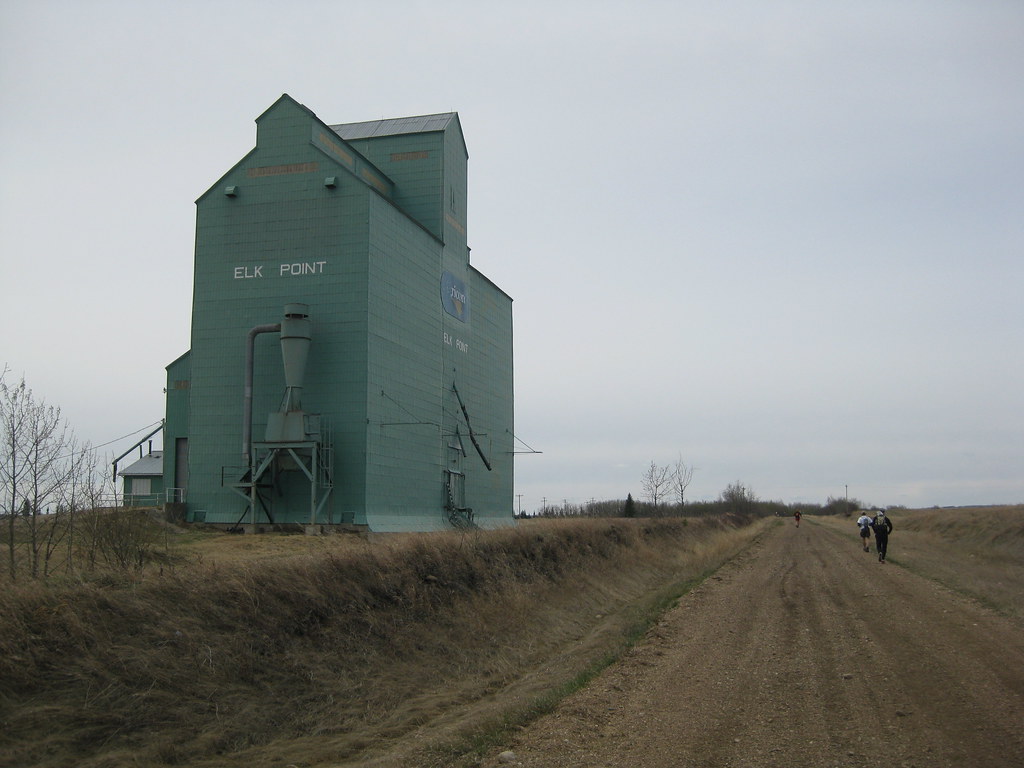
Leg 3 zigzagged through a variety of habitats including a trip up Moose Mountain and a beautiful stretch along the shores of Moosehills Lake. The leg ended by turning east toward St. Paul and following a gravel road into the town of Elk Point.

From Elk Point the 100 milers turned southeast towards Lindbergh while the rest of us headed toward the finish line. I changed my shoes at the aid station to cope with a hot spot on my heel that I think was a combination of the heel-tugging mud and the camber of the road. Other than that minor inconvenience I was feeling good and was excited about the possibility of finishing before dark.

Much of Leg 4 was also a road of sorts that gradually climbed over much of its length. Now that finishing wasn't a question I felt a little less guilty about walking some of these hills.

We left the aid station to start the fifth and final leg on yet another gravel road. Thankfully (and surprisingly) I never met a car on any of these roads so they were really more like broad trails.

It was at this point when I was very happy that I wasn't running 100 miles. Not surprisingly, I was tired and my hips and knees were sore from pounding on the downhills of the roller coaster gravel roads. However, I could see the many steeples of St. Paul, which gave me the motivation to run hard to the end.

The roar of the crowd carries me to the finish line with an official time of 12:35:59, which was good enough for 5th place amongst soloists.